This reading assignment is based on research I conducted during my research sabbatical in Spring 2026. But first, recall our general discussion on RFQs, cost breakdowns, outsourcing, competitive bidding, etc.
In our earlier lectures and readings, we discussed how supply chain management directly impacts profitability, return on investment (ROI), and a company’s ability to do things “better, faster, and cheaper.” One of the major ways companies improve performance is through outsourcing and strategic sourcing. Firms often outsource commodities, products with many qualified suppliers, because external suppliers may be able to produce them more efficiently and at lower cost. This process is commonly managed through RFQs (Requests for Quotations), where buying organizations ask suppliers to submit bids for business opportunities. While competitive bidding can reduce costs, the readings emphasized that simply forcing suppliers to rebid repeatedly often does not create the best long-term outcome. Suppliers may inflate prices from the beginning if they expect multiple bidding rounds, and excessive pressure on pricing can damage supplier margins, quality, service, and long-term relationships.
The readings also stressed that effective procurement goes beyond just obtaining the lowest price. Strong buying organizations analyze supplier cost structures, understand direct material and labor costs, and work collaboratively with suppliers to reduce underlying costs rather than simply “hacking away” at profit margins. We also discussed the important distinction between commodities and core or strategic parts. Commodities are often sourced through competitive bidding because multiple suppliers exist, while strategic parts typically require long-term partnerships, negotiation, collaboration, and trust because few suppliers may possess the required capabilities. Companies that outsource strategically often focus on maintaining flexibility, improving asset turnover, reducing inventory, and leveraging supplier expertise to increase ROI. In many ways, these earlier discussions laid the foundation for understanding how modern procurement organizations are beginning to use RFQs and supplier cost breakdowns not simply for price negotiation, but as sources of long-term cost intelligence and strategic decision-making.
If you carry this mindset into your career, you will likely think differently than many people around you. A large percentage of organizations still approach procurement and sourcing in a very tactical way, simply chasing lower prices, sending repetitive RFQs, and relying on spreadsheets, email chains, and “the way we have always done it.” However, the future of supply chain management belongs to professionals who can think strategically, interpret supplier data, understand cost structures, collaborate across functions, and use analytics and technology to make better decisions. Forward-thinking procurement professionals do not just negotiate prices, they help shape product design, reduce risk, improve supplier performance, and create long-term competitive advantage for their organizations. If you learn how to turn RFQs and supplier cost information into strategic intelligence, you will position yourself ahead of many peers who remain stuck in transactional purchasing mindsets. In many ways, this is where procurement and supply chain management are heading as AI, analytics, and digital systems continue transforming the profession.
OK, back to my sabbatical research…
The study surveyed 100 procurement and supply chain professionals across multiple industries to better understand how organizations use Requests for Quotations (RFQs) and supplier cost breakdowns after the initial sourcing event. In most supply chain courses, students learn how to collect bids and negotiate price. However, a much more important question is what happens after the quotes are received. Do companies simply select the lowest bidder, or do they use the information to drive should-cost modeling, engineering decisions, risk management, and strategic planning? This research was designed to answer that question. But first…here some examples of what companies could and should be doing with this super valuable information:
- Should-Cost Modeling
Definition: Estimating what a product or component should reasonably cost based on its material, labor, overhead, and production requirements, instead of simply accepting the supplier’s quoted price.
Simple Example: A supplier quotes a company $120 for a metal bracket. The buyer analyzes the steel cost, labor time, and overhead and estimates it should only cost around $95. The buyer then uses that information during negotiations. - Engineering Decisions
Definition: Using supplier cost information to help engineers redesign products so they are easier and cheaper to manufacture without hurting quality or performance.
Simple Example: Engineers discover that using a slightly different plastic material would reduce production costs by 20% while maintaining the same product quality. Procurement and engineering work together to make the change. - Risk Management
Definition: Identifying potential supply chain risks such as supplier disruptions, material shortages, geopolitical issues, or overdependence on one supplier.
Simple Example: A company realizes that an important electronic chip is sourced from only one supplier located in a region prone to natural disasters. The company decides to find a backup supplier before a disruption occurs. - Strategic Planning
Definition: Using procurement and supplier information to support major long-term business decisions related to sourcing, investments, supplier relationships, and company growth.
Simple Example: A company uses supplier cost data to decide whether to manufacture a product in the United States or outsource production overseas over the next five years.
My research findings reveal that many organizations are very good at collecting supplier quotes, but far fewer are able to convert those quotes into ongoing cost intelligence. In other words, they gather large amounts of pricing and cost data but often fail to turn that information into knowledge that improves design decisions, supplier relationships, and long-term competitiveness. For students preparing for careers in procurement, sourcing, and supply chain management, this study provides a roadmap for how the profession is evolving. Entry-level buyers may focus on competitive bidding and price analysis, but the most successful procurement leaders use supplier cost information to shape major business decisions.
The infographic below summarizes responses from 100 procurement professionals. Because the sample includes practitioners from a variety of manufacturing environments, the findings provide a strong snapshot of how RFQs are used in practice. The core insight is that RFQs are far more than administrative documents. They can become a rich source of cost intelligence if the organization has the processes, tools, and cross-functional support needed to use them effectively.
How Companies Use RFQ Cost Breakdowns
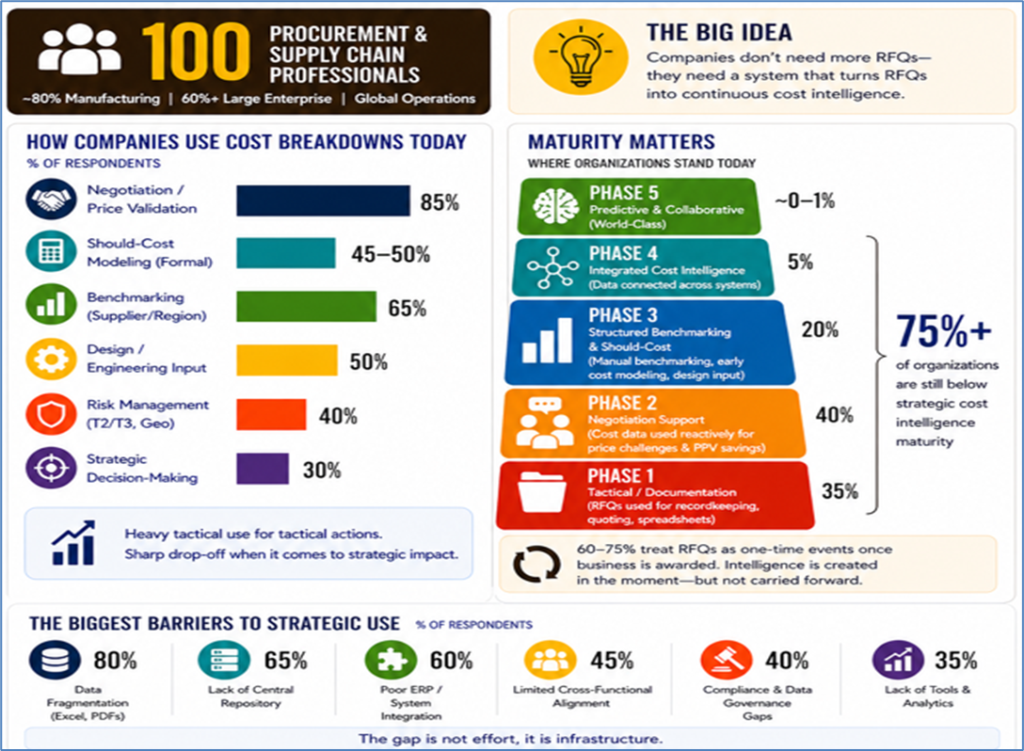
The strongest finding was that 85 percent of respondents use cost breakdowns for negotiation and price validation. This confirms that most organizations still view RFQs primarily as a way to challenge supplier pricing. Seventy percent reported using the data for should-cost modeling, indicating that many firms estimate what a part should cost based on material, labor, and overhead assumptions. Sixty-five percent use the information to benchmark suppliers across regions and cost structures. Fifty percent use it to support design and engineering decisions, 40 percent apply it to risk management, and 30 percent use it in broader strategic decision making. This progression shows how procurement can move from tactical price management to enterprise-wide strategic influence.
Barriers to Strategic Cost Intelligence
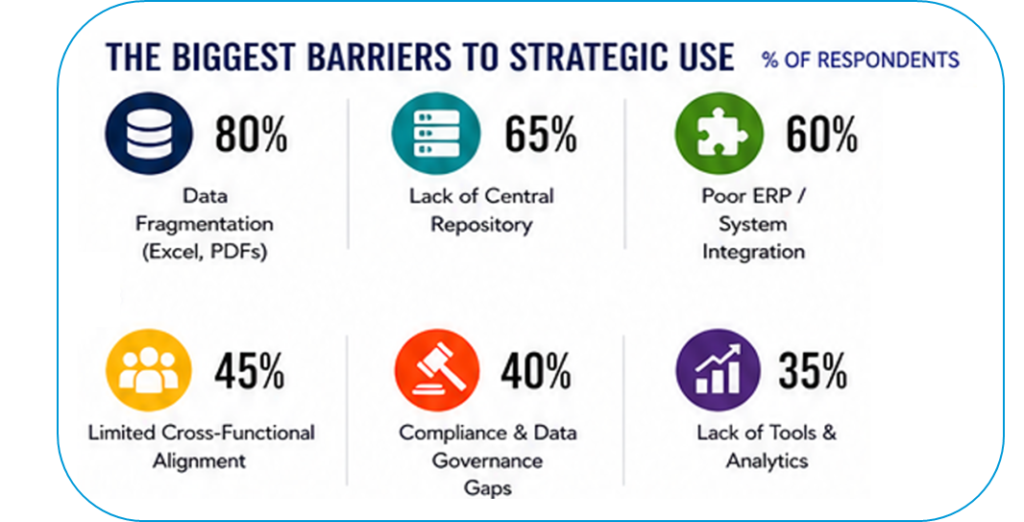
The research also identified several barriers. Sixty-five percent cited the lack of a central repository, meaning valuable RFQ data remains scattered across email inboxes, spreadsheets, PDFs, and shared drives. Forty-five percent reported limited cross-functional alignment, suggesting that procurement, engineering, finance, and operations often do not work together effectively. Forty percent pointed to data governance and compliance issues (i.e., who owns and manages the data?), while 35 percent noted insufficient tools and analytics. These findings demonstrate that the challenge is not collecting data; it is organizing, sharing, and using it consistently.
RFQ Cost Intelligence Maturity Model (see right hand side)
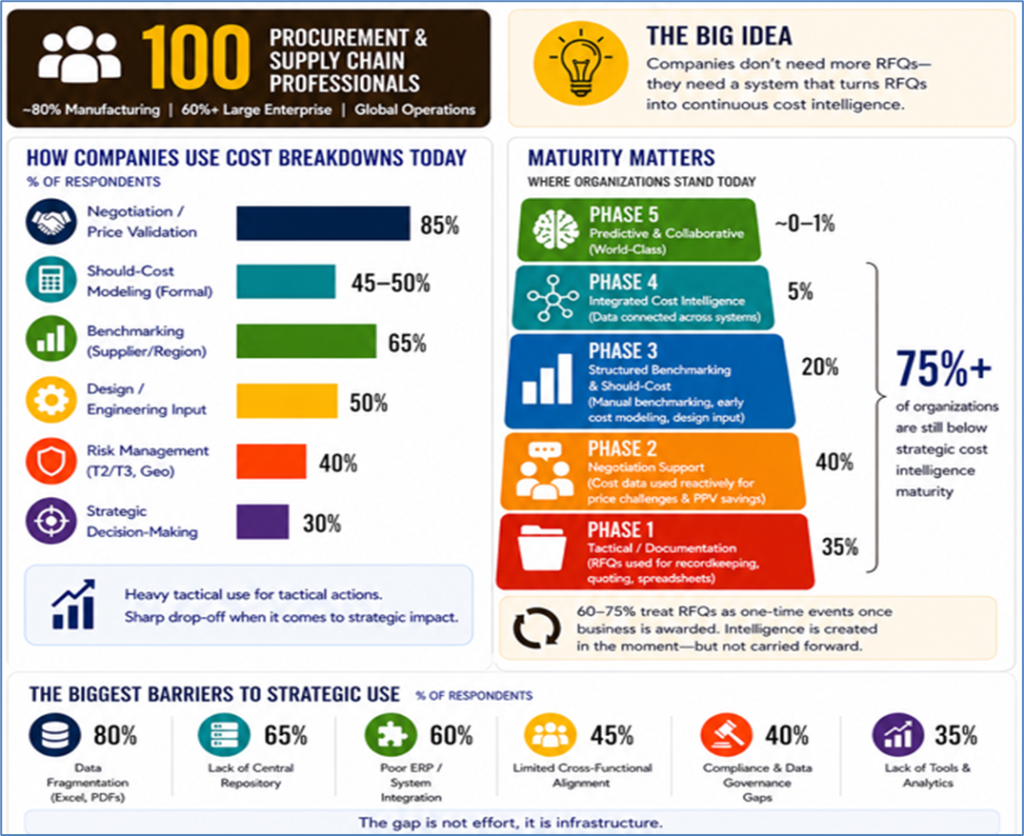
The study introduced a five-phase maturity model. Phase 1, Tactical Documentation, treats RFQs as paperwork and recordkeeping. Phase 2, Negotiation Support, uses cost breakdowns to challenge supplier quotes and support PPV metrics. Phase 3, Structured Benchmarking and Should-Cost Modeling, adds analytical rigor and cross-supplier comparisons. Phase 4, Integrated Cost Intelligence, connects procurement data with ERP systems, Power BI, CAD, and cross-functional teams. Phase 5, Predictive and Collaborative Intelligence, uses AI and advanced analytics to proactively guide sourcing, supplier development, and risk management.
What This Means for Your Career
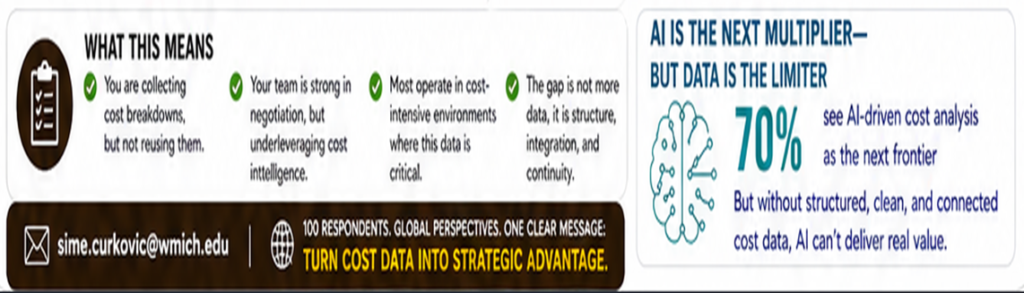
As a new SCM graduate, you will likely begin in roles such as buyer, planner, procurement analyst, or sourcing specialist. Early in your career, you may focus on RFQs, purchase orders, and supplier follow-up. Over time, your value will increase as you learn to interpret cost structures, build should-cost models, use analytics tools such as Excel, Power BI, and Python, and collaborate with engineering and finance. The future of procurement belongs to professionals who can transform supplier data into strategic insights rather than simply asking for lower prices.
AI, Automation, and the Future of Procurement
One of the biggest future implications of this research involves artificial intelligence (AI), automation, and predictive analytics. Many companies are now racing to integrate AI into procurement and supply chain management because the potential value is enormous. In the future, AI systems will increasingly automate repetitive procurement tasks such as RFQ comparisons, supplier quote analysis, purchase order creation, spend analysis, and supplier performance monitoring. More advanced systems will use predictive analytics to forecast raw material price increases, identify supply chain risks before disruptions occur, recommend alternative suppliers, estimate future should-cost targets, and even help engineers redesign products for lower cost and improved manufacturability.
For example, imagine a procurement analyst receiving 50 supplier quotes for a component. Instead of manually reviewing spreadsheets for several days, an AI-enabled system could instantly compare quotes, identify pricing outliers, highlight unusual cost structures, connect the quote to commodity market indexes, and predict whether steel or resin prices are likely to increase over the next six months. Similarly, AI systems may eventually help companies identify suppliers that are at financial risk, detect potential geopolitical disruptions, or recommend sourcing strategies based on historical performance data. In many ways, procurement professionals are moving from clerical purchasing roles toward data-driven business intelligence and decision-support roles.
However, one of the major lessons from this research is that companies cannot simply “plug AI” into broken processes, disconnected systems, scattered spreadsheets, and poor-quality data and expect great results. AI is only as good as the data, infrastructure, and processes feeding it. If RFQ data is scattered across email inboxes, PDFs, Excel spreadsheets, and shared drives, AI systems will struggle to generate accurate insights. If procurement, engineering, finance, and operations are not aligned, AI recommendations may conflict with business realities. If organizations lack data governance, standardized cost structures, or centralized repositories, AI systems may produce unreliable outputs or “hallucinate” inaccurate conclusions. In other words, AI can amplify both strengths and weaknesses. If the foundation is poor, AI may simply help organizations make bad decisions faster.
This is why the barriers identified in the research are so important. Before organizations can fully leverage AI and predictive analytics, they must first improve data quality, establish centralized repositories, standardize processes, strengthen cross-functional collaboration, and build better analytics capabilities. The companies that succeed with AI will not necessarily be the ones with the fanciest software. They will be the organizations that first build strong procurement systems, clean data structures, and disciplined decision-making processes.
This is also where future SCM professionals can become agents of change within their organizations. Many companies are still heavily reliant on manual processes, disconnected spreadsheets, tribal knowledge, and outdated sourcing practices. Young professionals entering the workforce with skills in analytics, Power BI, Excel, Python, ERP systems, AI tools, and cross-functional communication will often recognize opportunities for improvement long before others do. Rather than simply accepting “the way we have always done it,” forward-thinking SCM professionals can help organizations modernize procurement processes, improve visibility, centralize supplier intelligence, and create the infrastructure needed for AI to generate real strategic value. In many ways, the future leaders in procurement will not simply be the best negotiators. They will be the professionals who know how to combine supply chain knowledge, analytics, systems thinking, and AI into smarter business decision-making.
Conclusion
The RFQ process is one of the most important foundations of a procurement career. At first glance, it appears to be a straightforward method for collecting supplier bids and selecting the lowest cost option. This research shows that the real value lies in what organizations do with the information after the quotes are received. Supplier cost breakdowns can support negotiation, should-cost modeling, design improvement, risk management, and strategic planning. The most advanced companies are building centralized repositories and integrating AI to transform static quotes into living cost intelligence.
For supply chain management majors, this should be exciting. The profession is moving well beyond clerical purchasing and toward data-driven, cross-functional leadership. If you develop strong skills in cost analysis, analytics, communication, and supplier collaboration, you can progress from junior buyer to commodity manager, sourcing manager, director of procurement, and even Chief Procurement Officer (or CEO). In many ways, RFQs are the starting point for a career that can shape product design, reduce risk, improve profitability, and create lasting competitive advantage.
Sime (Sheema) Curkovic, Ph.D.
Professor, Operations/Supply Chain | Lee Honors College Faculty Fellow Western Michigan University |
Haworth College of Business Kalamazoo, MI 49008 | 269.267.3093 | Room 3246
sime.curkovic@wmich.edu | www.wmich.edu/supplychain