Man, procurement is changing rapidly. AI is really reshaping how sourcing professionals approach supplier risk monitoring, negotiation preparation, RFQ analysis, contract review, and spend analytics.
I recently surveyed more than 100 procurement and SCM pros to better understand how orgs are using supplier RFQ cost breakdowns. See results below.
One of the most interesting findings was that over 70% of respondents identified AI-driven cost analysis as the next major frontier for procurement.
At the same time, the research revealed that most orgs are not fully prepared to take advantage of AI (not even close).
Common barriers included:
• Data fragmentation across Excel files, PDFs, and email attachments (80%)
• Lack of a central repository for supplier cost intelligence (65%)
• Poor ERP and system integration (60%)
• Governance and data quality challenges (40%)
In other words, many organizations recognize the potential of AI, but still need the underlying data foundation and infrastructure to use it effectively.
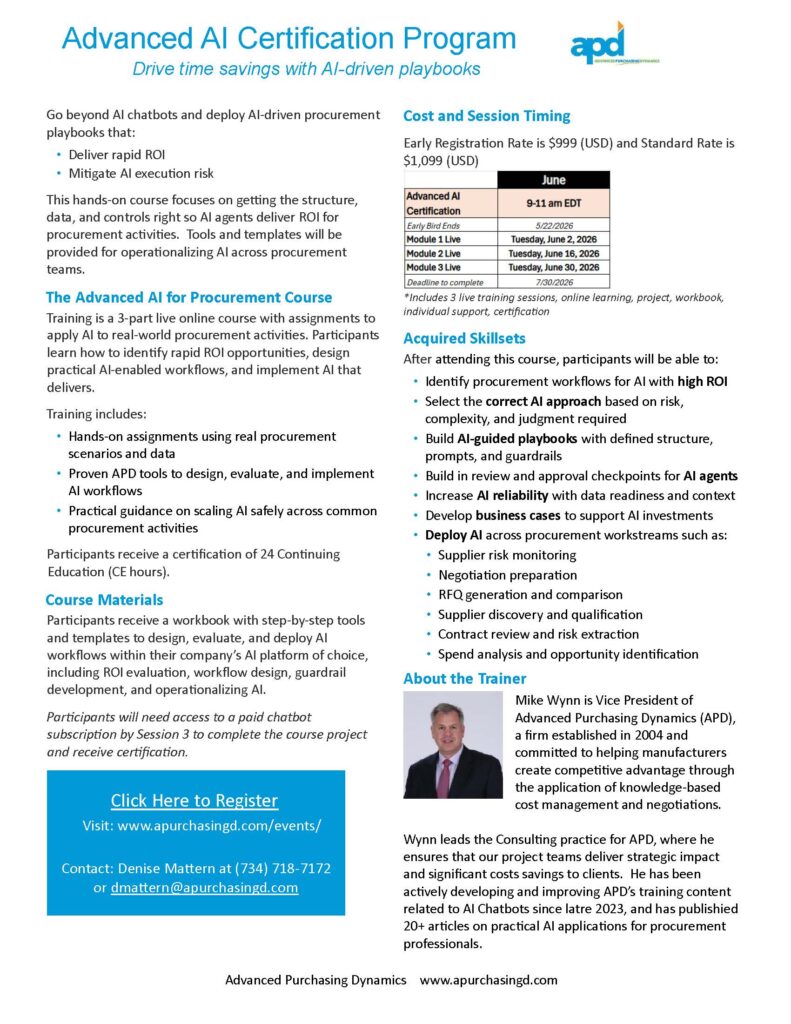
That is why I have decided to go through APD’s Advanced AI Certification Program myself. Back to school for me. They are also helping me develop this content for our students. Thank you APD!
I want to better understand how procurement teams can move beyond simply experimenting with AI and begin implementing practical, high-ROI applications in areas such as RFQ comparison, supplier discovery, negotiation support, and contract analysis.
The procurement profession is evolving quickly, and I believe those of us involved in teaching, research, and practice need to continue learning alongside industry.
AI may be the next multiplier, but data remains the limiter (for certain in the SCM space).
If you work in procurement or supply chain and are trying to understand where AI is headed, this looks like a very practical and timely program.
See you there:
https://lnkd.in/gWkKrEU2

One of the biggest takeaways from my RFQ research is that procurement orgs are already doing a lot of the hard work. Most teams are highly skilled at collecting supplier cost breakdowns and using them to negotiate better prices. The real opportunity lies in what happens after the sourcing event is over.
Too often, valuable insights are trapped in spreadsheets, PDFs, and email folders, and the org starts over the next time a similar part is sourced. Our findings suggest that more than 75% of organizations are still operating at relatively early stages of cost intelligence maturity, using cost breakdowns primarily for documentation and negotiation rather than as a strategic asset (one time events).
The companies that create the greatest advantage will be those that treat supplier cost data as an enterprise knowledge base that can be reused for benchmarking, should-cost modeling, engineering decisions, risk management, and eventually AI-driven analysis.
The core message of the study is simple: companies do not need more RFQs, they need a system that turns RFQs into continuous cost intelligence.

One of the clearest findings from our RFQ Cost Intelligence Research is that procurement leaders are very optimistic about AI, but most orgs still need to build the foundation required to use it effectively. Over 70% of the 100+ pros we surveyed identified AI-driven cost analysis as the next major frontier. At the same time, they pointed to significant barriers including data fragmentation, lack of a central repository, poor system integration, and governance challenges. The message was clear: AI has tremendous potential, but it can only amplify what already exists. If supplier cost data is scattered across spreadsheets, PDFs, and email attachments (which was almost everyone), even the most sophisticated AI tools will struggle to deliver meaningful insights (hallucinations).
In short, AI is the next multiplier, but data is the limiter. AI does not replace the need for clean, structured, and connected data. Instead, it magnifies the value of the info & processes already in place. Orgs that build a strong data foundation will be able to use AI to accelerate cost analysis, improve negotiations, identify risks, & uncover new sourcing opportunities.
Warning: Without clean, structured, and connected cost data, AI will make mistakes.
Sime (Sheema) Curkovic, Ph.D.
Professor, Operations/Supply Chain | Lee Honors College Faculty Fellow
Western Michigan University | Haworth College of Business
Kalamazoo, MI 49008 | 269.267.3093 | Room 3246
sime.curkovic@wmich.edu | www.wmich.edu/supplychain
Top 25 in U.S. (Gartner) | $70–80K starting | $100K+ by 30